“AI-Ready Product Engineer” Curriculum
Curriculum
Programming Education for Adults.
Curriculum Group Title
Software and Application Development and Analysis.
Objective
The educational programme trains AI-ready product engineers- These are professionals who hold technical range across the full shape of a modern software system like data, logic, interfaces, integrations and intelligence and who make judgement calls about scope, trade-offs and priorities, not only about implementation. Graduates acquire the practical skills, professional judgement and staged AI literacy to take up roles such as Software Engineer, Product Engineer, AI Engineer, Full-Stack Engineer or other technical position.
Target Group and Conditions for Starting Education
The applicant must be 18 years old, have previously acquired a basic education, have an intermediate level of English proficiency (B2) and passed an online test that assesses logical thinking and problem-solving skills. No prior knowledge of programming is required.
The programme is designed for candidates who are curious about technology, solution-oriented, self-directed, comfortable with ambiguity, and ready to take ownership of their work and grow through challenges. It is not suited to candidates seeking step-by-step guidance, easy answers, or a pre-defined learning path. To get accepted to the studies you need to pass the Selection Sprint.
Admission = Selection Sprint (156 academic hours, including 112 academic hours of classroom and practical work)
Before entering the programme, applicants complete the Selection Sprint, which is an intensive test period for delving into the fundamentals of programming in Java and development environments, consisting of two weeks on-site and one week of remote work.
This stage builds a strong foundation and helps assess whether candidates have the independence and self-direction needed to succeed in the programme’s peer-to-peer learning environment.
Candidates progress through short, automatically graded exercises, with exams at the end of the first and second weeks tracking progress; weekends are dedicated to teamwork on more complex problems. Throughout, participants are supported by team members and technical tutors, whose role is to guide through questions and hints rather than direct answers, helping candidates develop independent, creative problem-solving and peer-to-peer learning.
Learning Outcomes
AI-Ready Product Engineer curriculum (15 months, 3000 academic hours including 40 academic hours of classroom and practical work) consists:
- Programming Fundamentals and Backend (up to 6 months, 1200 academic hours, including 40 academic hours of classroom and practical work)
- Product Engineering (up to 9 months, 1800 academic hours).
Completion of the study program takes place on a new self-learning platform that has been developed to support the peer-to-peer learning method since 2023 by OÜ FutureCoders. The platform includes an automated application process, customizable tests, a gamified progress tracking system, and modules that allow learners to deepen into different programming languages and technologies.
While participating in the study program, the learner:
- writes program code in Java (backend) and JavaScript/TypeScript (frontend), applying data structures, testing and error handling;
- designs databases and product architecture, from single applications to layered, multi-service, message-driven systems;
- implements, installs, secures and tests backend services, REST APIs, and full-stack, real-time web applications;
- integrates artificial intelligence (large language models, retrieval-augmented generation, and vector search) into working products, and evaluates AI-generated output against defined criteria;
- deploys and operates solutions using containers, CI/CD pipelines, and production monitoring;
- makes and defends product and architectural decisions (scoping, prioritising, and evaluating work that has no single right answer);
- participates in software development both independently and in teams, using version control and structured peer-review.

Programming Fundamentals and Backend (up to 6 months, 1200 academic hours, including 40 academic hours of classroom and practical work)
Learners move from writing tested, well-structured code to building layered, persistent applications, to exposing REST APIs that other systems can call, to shipping multi-user services with authentication, authorization, concurrency and deployment. Alongside the technical arc, learners build the professional foundation of the programme: giving and receiving feedback, pair programming, code review, decision ownership, and a disciplined relationship with AI (learning to verify its output rather than trust it by default). When completing the , the learners’ progress is supported through various activities, where professionals in their field share their experiences in kood/Jam, kood/Talk, Code-Reviews with professionals, kood/Workshop and other formats. Various workshops and activities supporting career choices such as a career fair and mock interviews are also organised.
On completion Programming Fundamentals and Backend, the learner:
- writes tested code that handles invalid input, chooses data structures deliberately, and organizes code with clear separation of concerns;
- designs and queries relational databases, and builds applications with layered, fault-tolerant architecture;
- builds and secures REST APIs, understands HTTP at the protocol level, and prevents common injection vulnerabilities through parameterized queries;
- builds multi-user services using a server-side framework, with real authentication, authorization, and safe concurrent database access;
- deploys services with containers and ships tested code through a continuous-integration pipeline;
- collaborates through Git branches, pull requests and structured code review, and documents architectural decisions;
- uses AI as a verified tool for research, debugging and boilerplate generation, and reviews AI-generated output with the same scrutiny applied to a teammate’s pull request.
Programming languages: Java backend + JavaScript

Product Engineering (up to 9 months, 1800 academic hours)
Learners build and ship three progressively consequential products: a full-stack, real-time, user-facing platform; a multi-service, business-critical platform with payments and message queues; and an AI-native platform integrating large language models, retrieval-augmented generation and vector search. In parallel, learners build product judgement: validating assumptions before building, defining success criteria, prioritising under constraints, connecting technical decisions to business outcomes, and evaluating open-ended work that has no single right answer.
On completion Product Engineering, the learner:
- builds full-stack applications with a component-based frontend framework, working across two language ecosystems (backend language + JavaScript/TypeScript);
- handles real-time communication (WebSockets) and designs APIs for frontend consumption;
- decomposes systems into services with clear boundaries, using message queues for asynchronous processing;
- integrates third-party services — payment providers, OAuth providers — with transactional integrity;
- implements production security practices: role-based access control, two-factor authentication, and hardening against common attack classes;
- tests across the full stack, including distributed systems, load, and non-deterministic AI output;
- operates production-like infrastructure with monitoring, alerting and multi-environment CI/CD;
- integrates LLM APIs into working products — prompt design, function calling, streaming — and builds retrieval-augmented generation pipelines using embeddings and vector storage;
- designs AI-aware architecture that accounts for token cost, latency, caching and graceful fallback;
- makes and defends product and architectural decisions under ambiguity, and evaluates work against criteria of their own articulation.
Programming languages: Java backend + JavaScript & TypeScript frontend
Deep Dives (2-4 weeks)
In-depth elective module offering focused study in a specific area, to broaden competitiveness on the labour market: 3D&Animation.
Description of the Learning Process
The curriculum is based on OÜ FutureCoders application using self-study methodology and applying a peer-to-peer methodology grounded in social constructivism. This means that learners build knowledge through projects and structured peer-evaluation. Progress comes from completing projects of increasing complexity, evaluated by peers through a multi-stage review process.
The pedagogy rests on two complementary principles:
- A spiral curriculum revisits the same concepts at increasing depth, each return building on what the last one established.
- Horizontal integration connects concepts at a given moment: every topic answers the question that makes the next topic possible. The learner is always going deeper into something they already know, and wider into something that needs what they already know.
The duration of the full study process is 15 months as standard. Since the study is based on self-study and peer-to-peer methodology, it is possible to choose the pace of study, and it is possible to complete the program faster. Mandatory projects define what every graduate ships and optional projects create depth for learners who progress faster. The entire learning process takes place as practical and team work, which is supported by additional activities such as various workshops in cooperation with partners, meetings with professionals in their field, job shadowing and other events that support career choice.
Learning content takes four forms:
- Orientation content gives a zoomed-out map of the learner’s stage, at the start and end of each module.
- Meta-skill content addresses the professional posture underneath the technical work.
- Contextual content builds the mental model needed for the work ahead.
- Project briefs are the unit of progression: what the learner builds, under what constraints, and against what criteria.
Assessment
Learning outcomes are evaluated during the admission period through exams that take place at the end of the first and second week. Their results provide a clear overview of the candidates’ ability, development and readiness.
When completing the study program, the learning results are evaluated on an ongoing basis both through the control modules built into the learning platform, which check the reliability of the program code written by the learner, as well as by the fellow students themselves, based on the evaluation guidelines. The core assessment mechanism is the multi-stage peer-review, applied to every project submission:
- Preparation: the learner submits the work and prepares for the review session.
- Testing: the outcome is checked against the project’s defined criteria.
- Code review: reviewers and the author walk through the code and discuss the approach taken.
- Acceptance: a pass/fail decision is made and logged.
- 360 feedback: each participant gives structured feedback to the others.
Assessment is non-differentiated and focused on the learner’s development: a working solution that meets the task’s purpose and instructions earns the points assigned to that task; a learner cannot advance to a dependent task until the required outcome is demonstrated.
The curriculum is considered successfully completed only when the learner has achieved every learning outcome defined for the modules undertaken, as verified through the assessment process above.
Issued Documents
- Students who have completed the Programming Fundamentals and Backend will be issued a certificate.
- Students who have completed the AI-Ready Product Engineer (Programming Fundamentals and Backend and Product Engineering) will be issued a diploma.

Learning environment
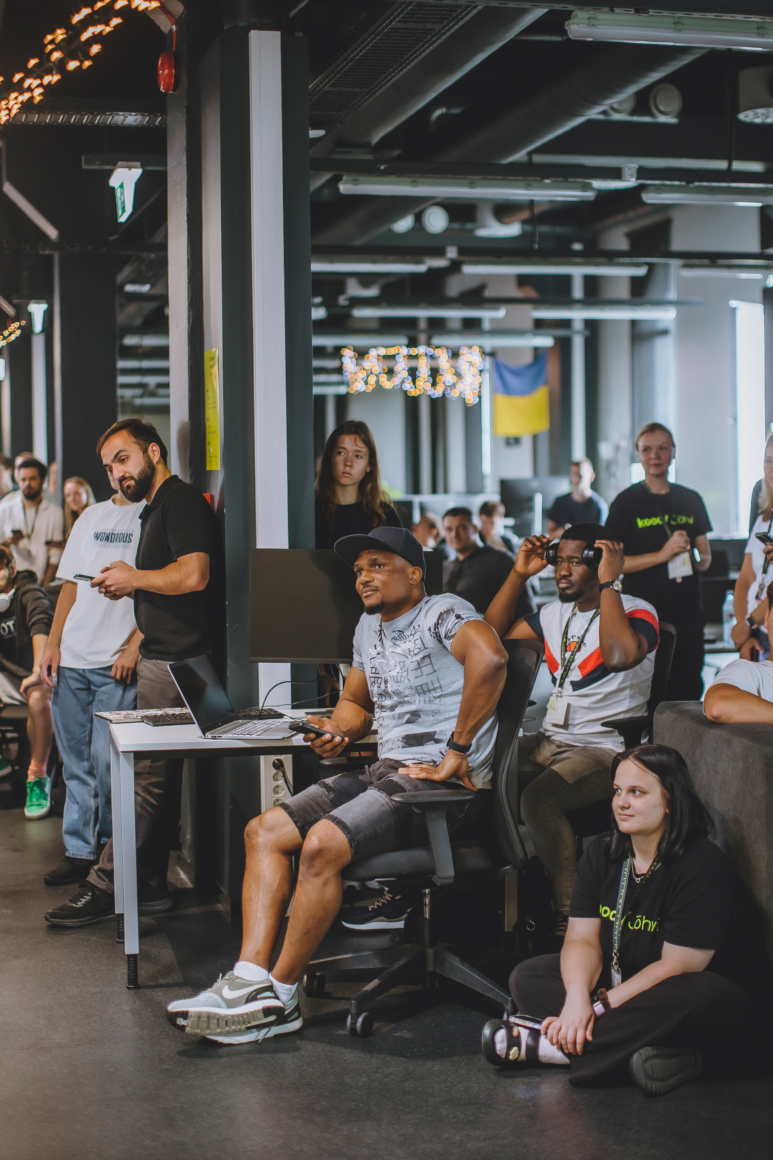
Contact learning takes place in //kood’s learning centres, including kood/Jõhvi (2. Tartu põik 5, Jõhvi), kood/Järva (Keskväljak 15, Paide) or kood/Võru (Tartu tn 25, Võru) in modern collaborative spaces equipped with the tools learners need. At every location learners hold personal door cards for 24-hour building access. Paid dormitory accommodation is available at kood/Jõhvi and in kood/Võru.
The programme can be completed in a hybrid or fully remote format, provided the learner meets deadlines and participates in scheduled on-site events where required.
Admission and Dismissal Conditions
On admission, the learner signs a Student Agreement with //kood one of the Learning Centres which are kood/Võru, kood/Järva or kood/Jõhvi (MTÜ Tuleviku Tehnoloogiaharidus). Under the agreement:
- //kood is obliged to provide access to and support in the self-study programme, deliver top-level software engineering education, and support the learner’s career.
- the learner is required to engage in the learning process in good faith and aim to be a full participant in the //kood learning community.
In order to provide access to education regardless of a candidate’s background or financial situation, //kood does not charge a tuition fee to start the program. To ensure the sustainability of the school and program, each learner enters into an Income Sharing Agreement to contribute back to the school and community later, once they have graduated. We have flexible payments, so tuition can be paid in installments or in full at any time.
The cost of the Programming Fundamentals and Backend is €2,500.
The cost of the AI-Ready Product Engineer (Programming Fundamentals and Backend and Product Engineering) is 4500€

Early Termination of the Students Agreement
//kood has the right to terminate the student contract early if:
- the Students Agreement is violated / an act is committed that endangers the good reputation of //kood or the students or employees of //kood.
- the student has achieved negative learning results, i.e. have acquired knowledge and skills that are below the required minimum and have not improved their results despite a written warning from the //kood.
//kood informs students of the termination of the Student´s Agreement and the costs involved within 30 calendar days from the date of termination of the Student Agreement. The student can pay the termination fee in full or in monthly installments until the fee for early termination of the Student Agreement is paid in full. The fee for early termination of the contract is paid proportionally to the number of months studied and is evenly distributed over the 1st – 15th academic months.
If the student terminates the Student´s Agreement, a digitally signed statement for terminating the learner’s contract must be submitted to students@kood.tech. In this case, the learner is obliged to pay the early termination fee to cover the study. The fee for early termination of the contract is paid proportionally to the number of months studied and is evenly distributed over the 1st – 15th academic months.
Quality Assurance Conditions
To ensure continuous development for learners and the ongoing quality of learning materials, //kood works with partner schools operating a similar methodology, as well as partner companies, and continuously adds to and revises the curriculum to remain aligned with the software engineering profession’s current requirements. Modules, topics and project assignments may be added, updated or removed with the goal of equipping learners with the skills and experience they need to secure their next role in the technology sector.
To monitor learner satisfaction, //kood collects a Net Promoter Score (NPS, visible on various metrics) (0–10 scale) together with qualitative feedback from learners, at the end of each test period, at the end of the Selection Sprint, and at defined points through the curriculum. Feedback is used directly to improve both the curriculum and the day-to-day learning experience.