Meet Kärt & Gregor – two unique journeys into coding
27.01.2026
Our Selection Sprint brings together people to learn coding from very different directions and this week, we’re meeting two sprinters whose journeys highlight just how varied those paths can be. Kärt, a 22-year-old KYC specialist working in Tallinn, was drawn to coding by a love of problem-solving and curiosity about how systems work behind the scenes. Gregor, a 20-year-old from Estonia, came to the Sprint after years spent on the football field, deciding to try coding simply to see if it might be for him.
Kärt – “Everyone can learn coding. The real question is whether it’s for you.”

Photo: First day of Selection Sprint 19
“My name is Kärt, I’m 22 years old, and I currently work in KYC Operations in Tallinn.”
Before coming to the Selection Sprint, Kärt had already lived quite a full life. She spent a year as an exchange student in Spain and later lived in Sri Lanka for seven months, where she surfed, practiced yoga, worked, and explored a completely different rhythm of life.
“I like problem-solving and maths,” she says. “And I wanted to understand how systems work behind the scenes.”
Although Kärt hadn’t coded before, she did prepare a little. After a recommendation during the pre-Sprint check-in info session, she completed a short Java beginners’ course.
“It was really helpful. I’d definitely recommend it to others,” she says. “At the beginning, there’s so much information, and having even a small foundation makes it easier not to feel overwhelmed.”
What surprised her most during the Sprint wasn’t the tasks, it was the people.
“The people are really nice and supportive. It feels a bit like a family here,” she explains. “It’s not just coding together – you cook together, play board games, watch movies, and explore places nearby.”
Outside of coding hours, Kärt and her fellow sprinters have explored Jõhvi’s nightlife, played board games in the evenings, watched movies, and took trips to Narva and Sillamäe.
And what about the common myth that you need to be great at math to code?
“I don’t think that’s true at all,” Kärt says. “Math is not the number one requirement. People solve tasks in so many different ways, you can always find an approach that works for you.”
Her advice to new sprinters is simple but honest:
“Stay open-minded. Be ready to try different approaches. Don’t put too many expectations on the Sprint beforehand, everything can change really quickly. And don’t get lost in coding. Stay connected with people.”
And to anyone hesitating, wondering ‘But can I actually learn coding?’ Kärt has a reassuring answer:
“I think everyone can do the Sprint and learn coding. The real question is not can I do it, but is programming for me. And the Sprint is an amazing way to find that out.”
Gregor – Trading the football pitch for lines of code
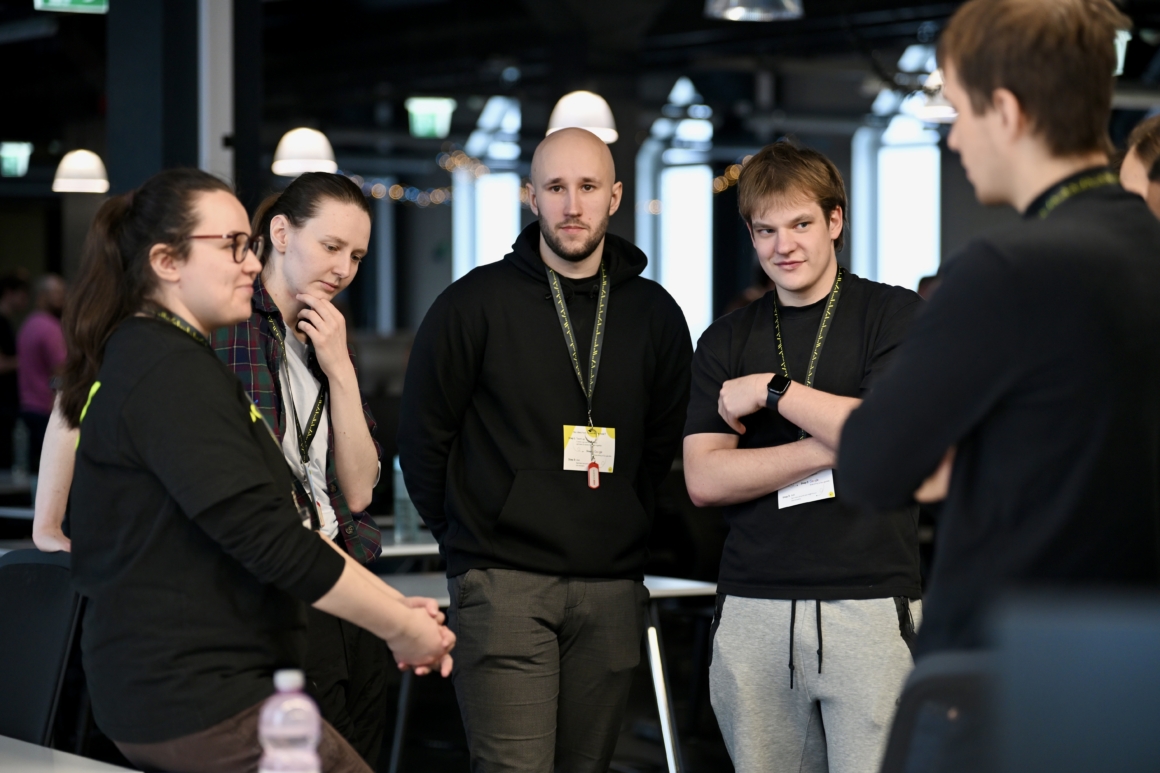
Photo: First day of Selection Sprint 19 (Gregor is second from the right)
“My name is Gregor, I’m 20 years old and I’m currently doing the Selection Sprint.”
Gregor had never programmed before coming to kood/Jõhvi. His path here wasn’t straightforward: he played football, studied for a year at TalTech and eventually realized that the university format just wasn’t for him.
“It wasn’t that the subject was wrong, the format just didn’t suit me,” he says.
After leaving university, Gregor spent months thinking about what to do next. Then he remembered hearing about kood/Jõhvi through Oskar Pedosk who is an alumnus and his former football coach, and decided to give it a try.
“I didn’t really have a big plan,” Gregor admits. “I just thought I’ll try.”
So far, he’s glad he did.
“I actually really like writing code,” he says. “Even more than the social side.”
One of the most exciting and unexpected parts of the Sprint for Gregor has been the freedom.
“I love that I can wake up at ten, code until five, eat, and then continue until midnight if I want,” he explains. “Being able to work on my own schedule is a huge plus.”
Does coding require strong math skills?
“I wouldn’t say math,” Gregor says. “It’s more about logic and understanding what needs to happen and in what order. Syntax can be learned. The important part is thinking things through.”
When it comes to daily tasks, Gregor has learned something important about focus.
“If you have daily tasks, don’t try to solve them alone in your room,” he says. “I tried that once I just ended up sleeping and getting hungry.”
Being in a shared space makes a difference.
“When everyone around you is working, it’s much harder to just lie around and do nothing.”
His advice to future sprinters is refreshingly straightforward:
“If you have the time and the opportunity just try. You can live here for two weeks without rent, so there’s really nothing to lose.”
And one final tip?
“Put in as many hours as you can. Sit down and write code as much as you’re able to.”
Join our next Selection Sprint and start your career in tech!
//kood was founded in Jõhvi, Estonia in 2021, with the aim of making technology education accessible to everyone and address the software developers shortage. From 2025, students can study in Jõhvi, Võru and Paide. Its 12–15 month curriculum is based on 100% practical, self-directed and peer-to-peer learning, covering full-stack software development, teamwork and problem solving. Students can later specialise in fields such as cybersecurity, mobile applications, or AI.
//kood has welcomed more than 1,200 students in Estonia with close to 400 graduates – half of whom are now working in the technology sector. Students represent over 30 different nationalities, 21% are women and the average age is 29. You can find the //kood peer-to-peer learning method and curriculum also in Finland, Ukraine and Kenya.
In 2025, the Estonian Ministry of Economic Affairs and Communications recognised //kood as one of the best entrepreneurship promoters in the country.
The accessibility of IT education is supported by Skaala, Swedbank, Wise, Kaamos, LHV, SEB, Barrus, SA Võrumaa Arenduskeskus, SA Järvamaa, ESTDEV and others.