Thrown into the deep end: //kood brings AI-era engineering to Moldova
22.06.2026
Estonia’s peer-learning technology school is opening in Chișinău this autumn. Behind the launch: a fast-moving partnership, a tech sector booming faster than almost anywhere on earth and a conviction that the next generation of engineers must learn to build with, and without AI.
//kood has never grown by looking at a map. “We don’t look at the world, point at a country and decide to plant a flag there,” says Lauri Haav, CEO of //kood. Its expansion is demand-driven: //kood shares what it does, points to the results it has achieved in Estonia and goes where it finds people who want to build the same thing for their own community. “Sometimes that makes our expansion look a little sporadic, but it is always rooted in real local appetite,” says Haav.
This summer, that place is Moldova. In roughly six months, from first conversations to launch, //kood is opening in the capital, Chișinău, in partnership with the Technical University of Moldova. The first Selection Sprint begins at the end of August 2026.
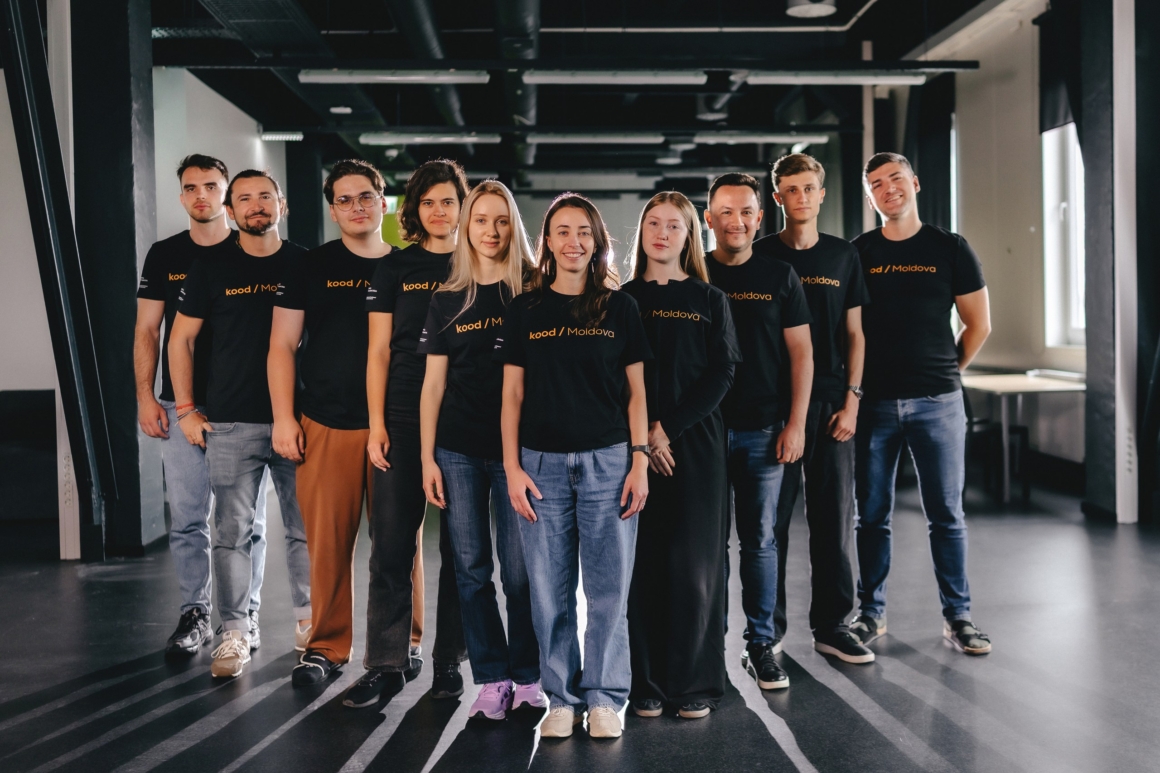
How it started
The match was, in part, a matter of shared history. Estonia and Moldova regained their independence within months of one another and have travelled parallel paths toward the European Union and the wider democratic world ever since. What turned that history into a project was a connection made through Practnet and the support of the European Commission, the route by which the Moldovan founders first met the //kood team.
kood/Moldova is owned locally. //kood supplies the backbone: the platform, the curriculum, the blueprints and the hard-won knowledge, while the local team shapes it for the realities of the Moldovan market. The school is starting in Chișinău because that is where the country’s IT industry and employers are concentrated and around it a consortium of local employers is forming to help fund the school. In the end, it is built for them and the talent they need.
Why it matters
Moldova’s tech sector is one of the country’s quiet success stories. Thanks to the Moldova IT Park and its strikingly simple 7% flat tax on turnover, the industry has grown by double digits for a decade and now counts more than 2,500 companies. By 2023 its output had caught up with where Estonia’s IT sector stood in 2015. High-speed broadband reaches 99% of the territory, legislation keeps harmonising with Europe and the universities turn out genuinely talented graduates.
But there is a gap. Much of the sector still lives in outsourcing and services, where the higher value and salaries are captured by someone else. The leap to building products needs a particular kind of person: an engineer who can also think like a product builder. Universities produce excellent computer-science and mathematics graduates, Haav notes, but rarely product engineers and “today’s juniors don’t look at all like the juniors of five years ago,” leaving employers to train them from scratch.
That is the gap //kood’s new curriculum is built to close. Its name says it plainly: AI-ready product engineer. The expectation now, Haav argues, is that graduates can build with AI and without it, and he is blunt about the difference between real engineering and the “vibe coding” trend lighting up his feed:
“If I buy a good cake mix, I can bake a perfect cake, add whipped cream and cherries, and serve it at a kid’s birthday party. Does that make me a professional baker? It doesn’t. It’s a hobby project,” comments Lauri Haav.

As //kood AI-Literacy Curriculum Advisor Ivo Kund (ex-CTO of Pactum, Estonia’s first AI-startup) eloquently puts it: “Vibe coding and AI-driven engineering live in two different universes, with different laws of physics.”
Far from threatening skilled engineers, AI makes them stronger. “It’s a force multiplier,” Haav adds. “The more you know, the more it helps you.”
There is a bigger reason this work matters. In the Global Startup Ecosystem Index 2026, Moldova was named one of the world’s fastest-growing startup ecosystems climbing eight places to 82nd globally on 91.9% annual growth, the highest rate in Europe and the third highest in the world. Chișinău entered the global top 500 startup cities for the first time.
And in a country under constant hybrid pressure, technology is also a matter of national security. “We have drones and rockets crossing our airspace almost on a regular basis,” says Dumitru Alaiba, Moldova’s former Minister of Economic Development and a driving force behind kood/Moldova. Investing in technology and talent, he argues, is ultimately a way to build resilience.
Join the first Sprint in Chișinău
The first Selection Sprint runs on-site in Chișinău at the end of August 2026, with the Technical University of Moldova, opening its doors to a first cohort of around 60-80 future product engineers. It is intensive and in person, the place where you find out whether this path is for you and no prior coding experience is required. Just curiosity, grit and a willingness to be thrown in at the deep end.
Catalina Plinchi, co-founder of kood/Moldova, knows the feeling. Before the launch she went through the Sprint herself in Estonia, alongside nine other Moldovans, to experience it as a real student. Here is what she says: “I decided to test it on myself. To see, as a real student, what it’s like to go through the Sprint, to feel the vibe and the energy. I’d heard it’s a life-changing experience. It is. They just throw you in an ocean and you have to swim. But the best part is that you’re not alone in that ocean, there are other coders, other students there to help. You build lifelong friendships, you spend day and night together solving problems and challenges, and it’s really, really nice.”
If that sounds like your kind of challenge, this is your moment. Applications for the first kood/Moldova Selection Sprint are open now. Join us in Chișinău this August and start building the //kood way.
First Selection Sprint · Chișinău · End of August 2026
On-site with the Technical University of Moldova.
~80 places in the first cohort.
No coding experience required.
APPLY NOW at kood.md
This blog post is based on an interview given to Geenius media on 11 June 2026. Quotes have been lightly edited for length and clarity.