Can you work and study at the same time? Yes, but it’s not easy – Saba’s story
28.04.2026
If you’ve read our previous story, you might remember Saba – an Anti-Money Laundering Specialist at Wise, originally from Pakistan, standing at the edge of a career change and stepping into the unknown world of coding. During the Selection Sprint, she navigated steep learning curves, moments of doubt, and small wins that hinted she might be on the right path.
She has now graduated and is working at //kood as a Junior Product Engineer. Follow along to see what happened after the Sprint and gain insights and advice for future students considering balancing work and studies at the same time.
What has happened since the Selection Sprint?
I still remember the tense weeks after the Selection Sprint, obsessing over whether I had done enough to pass. Then, on July 5th 2024, I got the email: I was in. I called my partner and family straight away, ignoring the time zones. From that moment, I knew I was going for it.
Before school started, I sorted out study leave, enjoyed some free time, and warned my friends I’d be “out of action” for the next 18 months.
The beginning felt familiar, with small tasks at my own pace. But as things progressed, so did the pressure, especially during group projects, where others relied on my work to move forward.
Balancing work and studies for a year and a half was a wild ride. By late 2025, I knew it was time for a change. When a Junior Product Engineer role opened at //kood, it felt like the perfect next step.
A few interviews later, I got the offer. Two weeks into the role, I’ve already fixed my first bugs and done my first production deployment and I’m excited for what’s ahead.
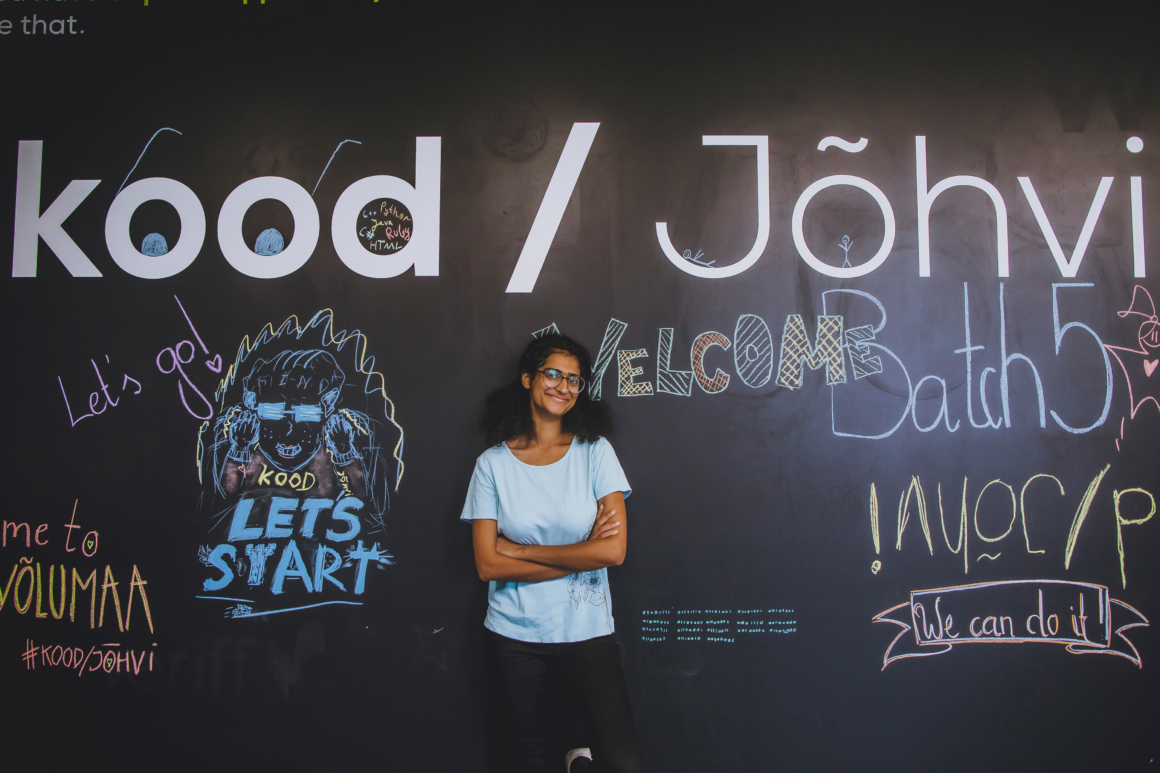
Saba at batch 5 opening day at kood/Jõhvi
If we go back to the beginning, do you remember what almost stopped you from applying and what made you go for it anyway?
The biggest hurdle was my full-time job. I knew leaving wasn’t an option, and I was worried that trying to balance work and studies would be incredibly hectic, with a huge impact on both my professional and personal life.
However, I also knew my situation wasn’t going to change on its own, I wasn’t exactly expecting to find a money plant in my backyard, and I wasn’t getting any younger. I realized there would never be a “perfect” time, so I might as well give programming a go now.
A chat with a colleague at Wise really helped push me forward. He was already enrolled at kood/Jõhvi while working in my team, and he reassured me that the workload was manageable if you stayed disciplined.
The school’s Income Share Agreement also made it feel like a safe bet. Knowing I would only pay back the tuition if I landed a technical job above a certain salary threshold took the financial pressure off. If I didn’t succeed, I wouldn’t owe anything, so I felt I had everything to gain and very little to lose.
Before starting the studies, what were you most worried about and how did reality compare?
Honestly, my biggest fear was burnout. Balancing a full-time career with intense coding was a massive undertaking. Looking back, I definitely had some very stressful moments, but fortunately, I never hit a breaking point.
How did you actually manage working and studying at the same time – what did your typical week look like?
This is a tricky question, I didn’t have a perfectly stable routine. While I usually aimed to study for a few hours every day, some workdays were so intense that I just didn’t have the mental energy left to code afterward.
My job at the time was in Financial Crime prevention at Wise; a role I was very passionate about. It was highly analytical and could be emotionally and mentally taxing depending on the cases I was handling. I often needed a “buffer” between my two worlds. I’d intentionally do something that didn’t require much brainpower right after work like cooking or taking a walk, just to clear my head before diving into my studies.
There were also weeks where I’d basically dedicate my entire weekend to catching up. Fortunately, my employer was supportive, and I was able to take 30 days of study leave per year. This allowed me to work in “sprints” during my days off, which is really what kept me from lagging behind. It was a constant balancing act, but finding those windows of time made it possible.
What was the hardest part of doing both (work + studying) that people should be prepared for?
The hardest part is accepting that you have to give up parts of your life. I had to sacrifice so many hobbies, travel less, and see my friends much less often. There were so many times I wished for more than 24 hours in a day. Even when I did take a weekend off, I rarely felt truly “stress-free” because those pending projects and reviews were always hanging out in the back of my mind.
It also starts to take over your headspace. I can’t tell you how many times I dreamed about programming bugs or architectural discussions because I’d be studying right up until I hit the pillow.
I even had to turn down a few professional opportunities that were great for my career and would have been more financially rewarding. I knew that starting a demanding new job during the day while learning brand-new tech every evening would just lead to burnout.
If I could pass on one piece of advice I received: don’t compare your pace to peers who aren’t working full-time. Imposter syndrome is already huge when you’re learning IT; don’t make it worse by comparing your “Part-Time” speed to someone else’s “Full-Time” speed.
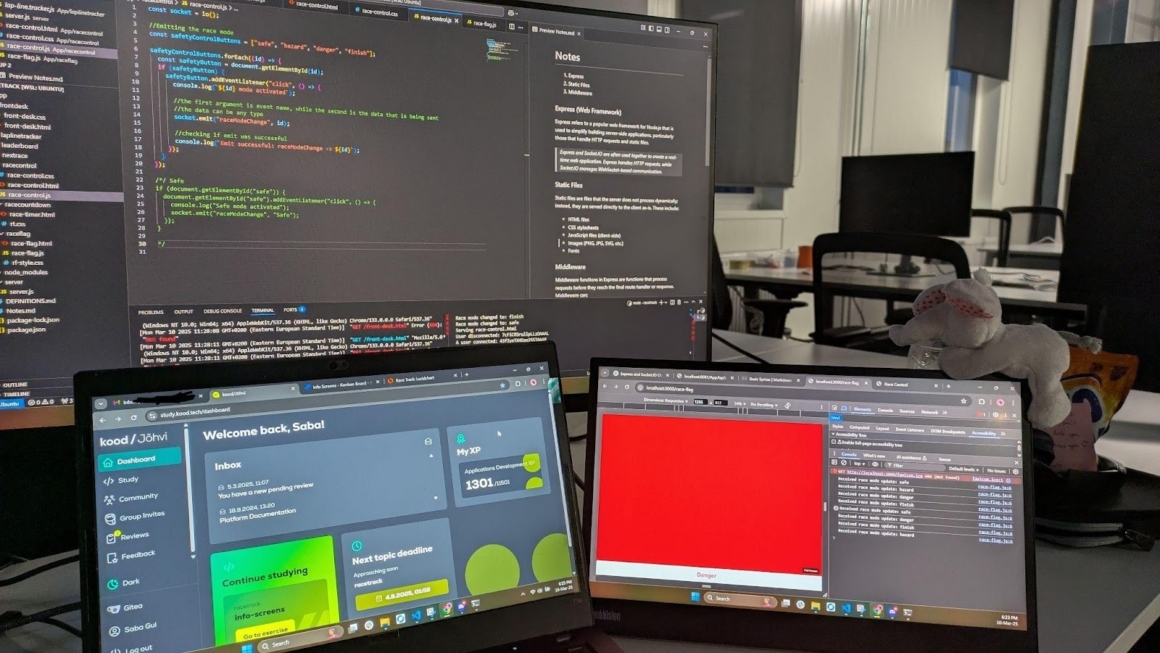
First group project at kood/Jõhvi
Did you ever feel like quitting? What helped you push through those moments?
No. While I definitely had moments where I questioned if I was “good enough” to land a job or if I’d made the right choice, I never actually thought about quitting.
What practical habits or systems helped you stay on track (even when you were tired or busy)?
I pushed myself to do something every day, no matter how small, just to keep the routine alive. Some days that meant reading a single technical article; other days, it was just committing a tiny text change or styling a single UI button.
As I mentioned before, having that physical buffer, like a walk, a bicycle ride, or cooking between my “work brain” and “study brain” was also essential for resetting my focus when I was tired.
What do applicants who are working usually underestimate about this journey?
The sheer scale of the commitment. The practical implications are also huge, not only on your personal but also professional life.
How important was support (family, peers, //kood community) in making this work?
I was incredibly lucky to be surrounded by people who sometimes believed in me more than I believed in myself. My friends, family, colleagues, and partner really looked after me; they kept reminding me that I could do this and that they were proud of me. That emotional support was what kept me going.
My main project partner at school was also a lifesaver. She was a friend who truly understood my work routine and was always flexible enough to have project discussions in the evenings. Even other students during peer reviews were cooperative, helping to schedule meetings after my work hours.
Now that you’ve just started working in a tech role – how does this moment compare to where you were when you first began your journey at kood/Jõhvi?
Standing here now makes me realize it was all worth it. Being on the job helps quiet the imposter syndrome; I can see that I actually gained the skills to contribute for real.
What makes it even better is the “full circle” aspect. I am not just in a tech role; I’m building the very platform that taught me how to code. Transitioning from a student who used the product to an engineer who improves it is a pretty incredible feeling. It makes the long nights and sacrificed weekends feel like a fair trade.
What would you say to someone who is working, feels stuck in their career, and is considering applying – should they do it, and what should they know first?
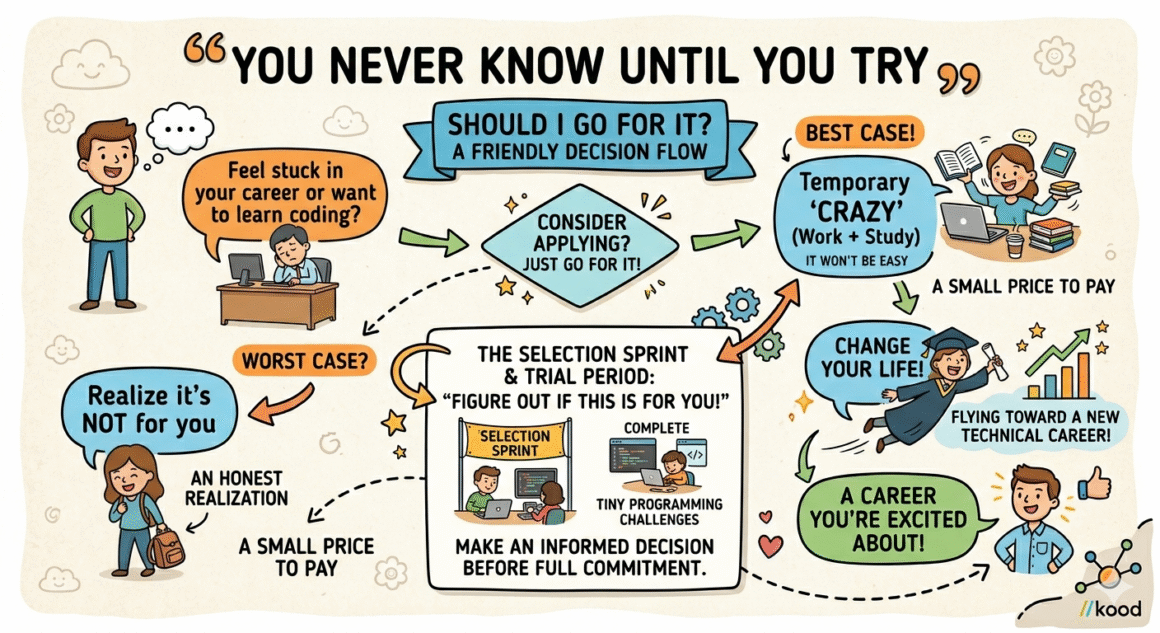
I am a staunch believer of “you never know until you try,” so my advice is to just go for it. The Selection Sprint and the initial trial period would help you figure out if this is for you, so you can make an informed decision before you are fully committed.
What you should know first is that it won’t be easy, but if you feel stuck where you are, the temporary “crazy” of balancing work and study is a small price to pay for a career you are actually excited about.
Worst case? You realize it’s not for you and you move on.
Best case? You change your life.
As an engineer I love making flowcharts before implementing features, so here is one representing the above 😀
//kood was founded in Jõhvi, Estonia in 2021, with the aim of making technology education accessible to everyone. From 2025, students can study in Jõhvi, Võru and Paide. Its 15-month curriculum is based on 100% practical, self-directed and peer-to-peer learning, covering full-stack software development, teamwork and problem solving. Students can later specialise in fields such as cybersecurity or mobile applications.
//kood has welcomed more than 1,300 students in Estonia with close to 500 graduates – half of whom are now working in the technology sector. Students represent over 30 different nationalities, 21% are women and the average age is 29. You can find the //kood peer-to-peer learning method and curriculum also in Finland, Ukraine, Kenya and Moldova.
In 2025, the Estonian Ministry of Economic Affairs and Communications recognised //kood as one of the best entrepreneurship promoters in the country.
The accessibility of IT education is supported by Skaala, Swedbank, Kaamos, LHV, SEB, Barrus and others.